
Low-Noise Gear Design for NVH-Controlled Transmission Systems

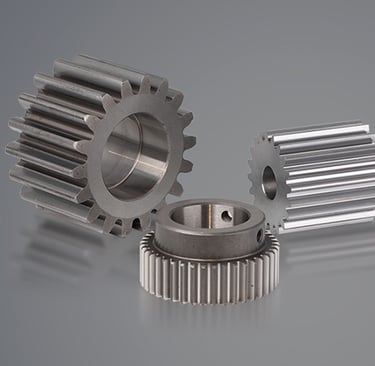
“NVH control for gears relies on tooth modification, precision control, proper lubrication, and stable meshing to reduce vibration and running noise.” Noise, vibration, and harshness (NVH) in a transmission arise from interacting factors: gear design, manufacturing accuracy, assembly, operating loads, and the way the surrounding structure and enclosure transmit sound. Controlling one factor alone rarely resolves the full problem.
Tooth geometry is a central design consideration. Profile modifications can compensate for predictable elastic deflection under load, while lead modifications help maintain contact across the face width despite shaft or housing movement. These adjustments support smoother tooth engagement and reduce transmission error, a key source of periodic vibration and gear whine. Backlash must also be managed: excessive clearance can contribute to impact and rattle, while insufficient clearance may increase friction or risk binding as temperatures and loads change.
Contact ratio, surface finish, and alignment further influence meshing behavior. A suitable contact ratio can spread load across more than one tooth pair for part of the mesh cycle, helping reduce fluctuations. Accurate finishing limits roughness that can generate friction and excitation, and careful alignment helps avoid concentrated contact at a tooth edge. Together, these measures can reduce uneven engagement, but they must be matched to the application rather than treated as universal settings.
Such considerations matter in reducers used in packaging machinery and indoor food factories, where operators may work close to equipment. Repetitive tonal noise can affect comfort and make communication more difficult, particularly during long shifts. Hangzhou Ocean Chain Industry Co., Ltd. optimizes gear geometry for low-noise reducer applications, with effective choices depending on the duty cycle, load, speed, mounting arrangement, and enclosure.
In practice, a low-noise gear is achieved through coordinated design and production control. Geometry, tolerances, material and finishing choices, lubrication, and assembly quality must work together to deliver stable meshing under actual operating conditions. Evaluating the complete transmission system helps ensure that improvements in the gear pair translate into meaningful reductions in vibration and running noise.
Material selection can influence gear noise through stiffness, damping, wear resistance, and the ability to preserve accurate tooth geometry under load. Steel gears provide high strength and dimensional stability for demanding loads and temperatures, making them suitable where deflection must remain controlled. Suitable polymer gears can reduce transmitted vibration and operating noise in lighter-duty applications because of their damping characteristics and lower mass. However, polymer performance must be assessed for temperature, moisture, chemical exposure, creep, and load capacity. Neither material guarantees quiet operation; design, manufacture, installation, and service conditions all contribute.
Manufacturing precision is equally important. Tooth accuracy, runout, pitch error, heat-treatment distortion, and consistency between mating gears determine how smoothly teeth enter and leave mesh. Errors can create repeated mesh impacts, increase gear howling, or produce tonal vibration that travels through the transmission housing. Precision inspection and compatible gear pairing help reduce these excitation sources, though housing stiffness and alignment also matter. Lubrication separates tooth surfaces, limits friction and wear, and supports smooth engagement. The lubricant’s type and viscosity must suit gear material, speed, load, and operating temperature. Too little lubricant, excess churning, unsuitable viscosity, or neglected replacement can raise noise and temperature.
For packaging and food-factory equipment, assess load and speed alongside available space and ambient conditions. Consider cleaning chemicals and washdown exposure, required lubricant and hygiene standards, and whether lubrication points remain accessible for inspection and maintenance. Select materials and sealing arrangements that tolerate the actual environment, then verify gear capacity and expected service life under realistic duty cycles. Hangzhou Ocean Chain Industry Co., Ltd. is a supplier whose gear-geometry optimization should be evaluated alongside application-specific material choices and manufacturing requirements. Request evidence on tolerances, process control, and suitability for the intended operating conditions, rather than relying on geometry claims alone. Pilot testing can confirm noise and durability.
The following troubleshooting guide links common gear noise, vibration, and harshness (NVH) symptoms with possible causes and practical checks. Treat each symptom as evidence to investigate, not as a diagnosis by itself; several faults can produce similar behavior.
Steady gear whine or howl — Likely causes include tooth errors, excessive transmission error, an unsuitable contact pattern, or resonance. Inspect the mesh and alignment, assess the contact pattern under representative load, and compare noise across operating speeds to identify resonant ranges.
Periodic knocking or rattling — Excessive backlash, loose components, or fluctuating load may create intermittent impacts. Check gear clearances, fasteners, coupling condition, and whether the applied load is stable during operation.
Vibration that rises with speed — Runout, imbalance, misalignment, or structural resonance may be responsible. Measure vibration across a suitable speed range, then inspect the installation, shafts, supports, and connected equipment for alignment or mounting issues.
Noise that worsens under load — Deflection, poor tooth contact, inadequate stiffness, or lubrication problems can increase noise as torque rises. Verify the contact pattern, confirm operation within rated load, and check that the lubricant is appropriate and correctly supplied.
Noise that develops over time — Wear, contamination, pitting, or lubricant degradation may cause a gradual change. Inspect tooth surfaces and lubricant condition, identify contamination or damage, and establish maintenance or replacement actions based on findings.
A disciplined diagnosis begins by recording noise and vibration at defined speeds and loads. Distinguish tonal components associated with gear-mesh frequency and its harmonics from broadband mechanical noise, which may indicate impacts, friction, or other sources. Next, check mounting and alignment, verify lubrication, and inspect gear contact and tooth condition. Change one condition at a time where practical so that results can be compared and causes isolated.
For meaningful comparisons, keep microphone distance and position, background conditions, speed, and load consistent between measurements. Record these conditions with each result; otherwise, changes in the test setup can be mistaken for changes in gearbox NVH.
There is no universal acceptable noise limit for every gear or reducer. Sound readings vary with product size, rotational speed, load, measurement distance, enclosure, room acoustics, and the test method. As an initial screening reference, roughly 60–75 dB(A) at 1 m may be considered for some enclosed, small-to-medium industrial reducers operating under defined conditions. This range is neither a regulatory limit nor a guarantee that a unit will suit a particular installation.
For a meaningful comparison, use the manufacturer’s declared measurement distance, operating speed, load, and test procedure. Set project-specific acceptance criteria and check applicable workplace-noise requirements separately. A tonal gear howl can be especially noticeable even when the overall dB(A) reading seems moderate. Frequency analysis can help identify prominent tones, while vibration measurements provide additional evidence about gear, shaft, bearing, housing, or mounting behavior.
Why do gears hum or howl?
Periodic forces arise as gear teeth engage and disengage. These tooth-mesh forces may excite resonances in the gears, shafts, bearings, housing, or supporting structure, producing a hum or howl. Pitch errors, misalignment, unsuitable tooth contact, excessive backlash, wear, and lubrication problems can also increase noise. Diagnosis should consider operating conditions and vibration or frequency data, rather than relying on sound level alone.
Can material choice reduce gear noise?
In suitable applications, damping-capable materials such as polymers may reduce transmitted noise, particularly at modest loads. Material selection is not a standalone solution: designers must assess gear geometry, manufacturing precision, stiffness, temperature limits, lubrication compatibility, and required durability together. A quieter material may not meet load capacity, dimensional stability, or service-life needs in every duty cycle.
When specifying a reducer, document the operating speed and load range, measurement distance and method, enclosure and mounting conditions, target noise level, and any tonal-noise concerns. Also identify temperature, lubrication, service-life, and maintenance requirements. These details make supplier data comparable and support realistic acceptance testing. Engineers can discuss reducer duty conditions, target noise levels, and gear requirements with Hangzhou Ocean Chain Industry Co., Ltd. to help define a suitable, testable specification for their application.
Quality
Expert gear manufacturing with 20 years experience.
GET IN TOUCH
Tel:+86-571 88065675 | +86-571 88842852
E-mail:oceanindustry@vip.163.com
Fax:+86-571 88844378
Address:4th Floor, Block 2, Qianjiang Century Industrial Park, 2327 Hongning Road,Ningwei Town,Hangzhou, China
© 2005. All rights reserved.